
Project Overview: Roof-Mounted Solar PV Panels at Marton Primary Academy
Metrica Environmental Consulting was appointed to undertake a comprehensive glint and glare assessment for a roof‑mounted solar PV development at Marton Primary Academy in Blackpool. The scheme comprises two fixed‑tilt PV arrays installed on both sides of the school’s pitched roof, forming part of the academy’s transition toward clean and sustainable energy.
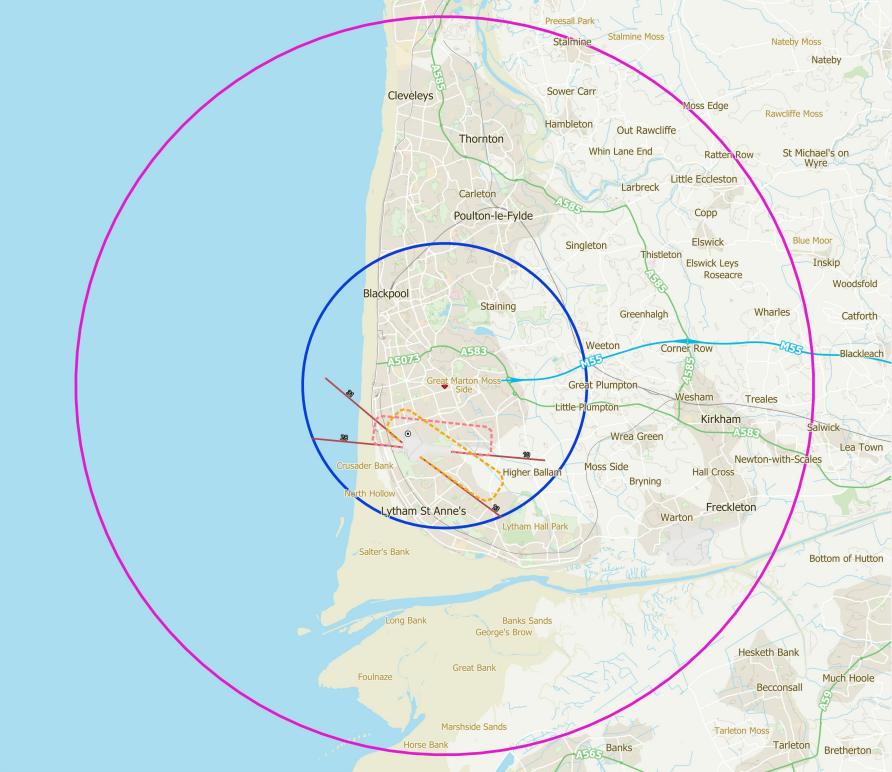
Our role was to provide a full, planning‑ready glint and glare assessment that addressed all potential effects on surrounding receptors, including residential properties, nearby transport routes, and aviation infrastructure; most notably Blackpool Airport, located 2.3 km to the southwest. Through detailed modelling and a robust best‑practice methodology, we ensured that all potential glint and glare concerns were fully evaluated and clearly evidenced.
Our Assessment Approach
Although the project is modest in scale compared with large solar farms, the sensitive location, surrounded by residential properties and within the safeguarding distance of an operational airport required a thorough and carefully reasoned approach.
Engagement with aviation stakeholders
Blackpool Airport’s safeguarding team requested that, in addition to standard runway approach paths, two visual circuits be included at 500 ft, 1000 ft, and 1500 ft. We incorporated these into the modelling to ensure all aviation concerns were fully addressed.
The result is an evidence‑led assessment that aligns both with technical expectations and stakeholder interests which is central to producing a defensible, planning‑ready report.
Glint and Glare Findings Across All Receptor Types
Blackpool Airport’s safeguarding team requested that, in addition to standard runway approach paths, two visual circuits be included at heights of 500 ft, 1000 ft, and 1500 ft. We incorporated these into the modelling to ensure all aviation concerns were fully addressed.
Our detailed modelling produced clear predictions for all receptor groups:
Residential Receptors: Of the numerous properties within the respective study area, only one dwelling was predicted to experience any glint or glare with values comfortably within the accepted thresholds for residential amenity; Road Users: With a low potential for temporary after‑image, some ‘green-glare’ was identified for drivers on Yeadon Way. This intensity is considered acceptable in terms of glint and glare, and no glare was predicted on the A5230 or the B5261; Rail Receptors: No rail receptors were identified within the defined study area, and therefore no impacts were applicable; and Aviation Receptors: No glare was predicted on any of the four runway approaches, or visual circuits at any altitude or at the Air Traffic Control Tower, meeting all relevant criteria.
These results are a product of the low‑reflective design of modern PV panels and the specific geometry of the proposed arrays.
Why Developers Trust Metrica’s Glint and Glare Expertise
Metrica Environmental Consulting continues to support solar developers, planners and local authorities with clear, robust, and defensible glint and glare assessments. Our approach is recognised for:
Strong technical capability in assessing glint and glare for solar PV developments of all scales; Transparent, evidence‑based modelling outputs that withstand scrutiny; Effective engagement with aviation stakeholders, local authorities, and transport bodies; Ability to simplify complex modelling into clear, planning‑ready conclusions; and Practical design advice that identifies and resolves issues early, reducing project risk.
For the Marton Primary Academy project, this approach ensured that all potential impacts were fully assessed and that the scheme meets all relevant criteria, supporting a smooth path through planning.